Wednesday, May 16, 2012

Buoys


May 15, 2012
Hypothesis- waves will be highest in the middle of Pacific Ocean.

I looked at several buoys in the middle of the Pacific Ocean, the Arabian Sea near India, the Atlantic Ocean off the cost of African, and the North Sea.  The highest wave I saw was in the Pacific Ocean and the lowest was off the coast of Africa.  I think wind pushing the water towards land makes the waves high.   There were many different types of buoys.  I saw a disc buoy, Oil Platform.  The most interesting one was on an oil platform in the North Sea.  The wind speed at that location (59.500 N 1.500 E (59°30'0" N 1°30'0" E) was 17.1 knots.  I think wind and weather patterns cause waves to become high or low.  Buoys are helpful to meteorologists because they collect data to help predict the weather at sea.   Buoys collect different data for many purposes like to know wave highest.  Boaters use buoys to tell if it is a good time to go fishing or not.  Buoys on the coast can help alter cities of possible tsunamis. In conclusion I believe that my hypothesis was correct based on the data I found. 


Wednesday, May 9, 2012

Making Waves lab & Simulation


Hypothesis - I believe that if you use a pipette to drop a drip of water into a pen, the water will ripple.

Observation - For the last two or three science classes, we have been learning about water wave in general.  So last class we used a simulation about the interactions of waves. You can drop drops of water in the simulation and it makes waves.   You and increase or decrease that amount of water dropped at a time and look at the different types of wave patterns.  What I noticed during the time I experimented with the simulation was that when you and a lower frequency of drops, the waves would be bigger and there would not be many of them.  When you had a high frequency, there are a lot of waves but they are very small.  I also noticed that the bigger the drop the higher the wave.

Making Waves lab
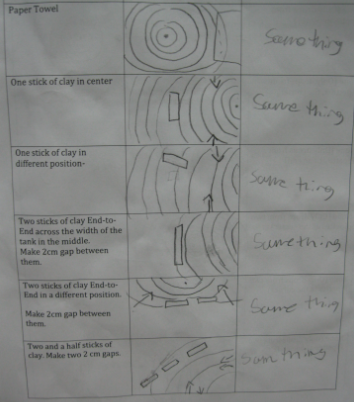
Analysis - Over two science class periods, we did a lab about making waves. During this lab, we actually made waves by dropping water into a pan of water using a pipette.  We did several experiments like dropping the drops in different corners of the pan and observing the different wave patterns.  We also put clay in the middle of the pans and then dropped drops of water into the pan to see what would happen.  What actually happened is that the clay acted like wall and the drops of water bounced of the clay.  Another thing we did was to put a paper towel on the side of the pan laying on top of the water.  Then we dropped a drop of water into the center of the pan to see what would happen.  What did happen was that the wave created by the drop continued underneath the paper towel.  The last experiment we tried was redoing all of our previous wave experiments but adding a cork into the pan.  What my partner and I noticed was that the cork didn’t change anything and all the experiments had the same result as they had without the cork previously.  

In my data I saw that the waves bounced off the edges of the pan and then faded away.  I also observed that the higher you dropped a drip, the greater the wave reaction it would cause.  This demonstrated that there is a relationship between the height at which a drip is dropped and the size of the wave created.


Conclusion – The behavior of waves is dependent on many different things.  In the situations we experimented with there is always a wave reaction creating a ripple effect on the surface of the water.  After doing this lab, I can now answer two of the three guiding questions.  Waves created by dropping water from a pipette into a pan of water create ripples on the water in a circular shape moving outward.  Waves interact with each other and solid objects by reversing direction.   I am not certain what properties a mechanical wave has.     

Monday, April 23, 2012


“Astronomy” End of Unit Reflection
Part 1
1.        In the past unit we learned that the earth’s and moon’s motions affect the tides and climate of earth.  The moon creates tides by the gravitation pull between the moon and the earth.   Earth’s rotation around the sun affects climate and creates the seasons.

2.       We learned that scientists use their knowledge of earth’s surface and atmosphere in search of extraterrestrial life.  Scientists know how earth supports life.  For example, oxygen, water, and reasonable temperatures are key things that are needed for us to survive.   Scientists look for these types of things when they study other planets to determine if they could possibly support life if any kind.    

3.       The International Space Station, space probes, and satellites are all excellent resources for space study.  In the ISS astronauts grow plants, do different types of tests and experiments to learn how gravity affects.  Satellites like the Hubble telescope send back pictures of planets, stars, and other galaxies that are better quality than scientists previously had. 
Part 2
1.       What effects are caused by the motions of earth and the moon?
Seasons, tides, day and night, eclipses, weather, and climate

2.       owH How has the development of technology and space flight helped astronomers learn more about other parts of the solar system and the structure of the universe?
The development of new technologies has helped astronomers because now they have stronger more effective telescopes to look into outer space.  With these new telescopes, astronomers have more accurate data and images to study our solar system and the structure of the universe.

3.       How are the conditions in space different from those on Earth?  How has space technology benefited modern society?
First off, in space there is no weather, oxygen, water or gravity.  The temperatures in space are very extreme.  To deal with these harsh conditions, astronauts must wear special space suits.  Space technology has benefited many different areas of modern society.  Examples include freeze dried food, fire resistant clothing, Velcro, smoke detectors, wireless tools, barcodes, Tang, and lasers.


Reflection
I enjoyed this unit VERY much.  It was one of my favorite units.  I think it is important to learn space because it is just amazing.  I learned that because of the space program we have more technology in our homes today than when my parents were kids like microwave ovens.  I really liked the videos we saw about the Hubble telescope and the ISS.  I also loved the planet and brochure projects.  What I didn’t like was tides since I found it confusing and didn’t really understand them.   Please teach tides in more detail.  Maybe a lab or experiment on tides would have helped me.

Tuesday, April 10, 2012


Space Exploration is it Worth the Cost?
Emma 7A
April/10/2012

Space is such a big place.   It is literally endless going on forever and ever.  It is full of planets, stars, different galaxies and more.   There is so much to explore but honestly is it worth the cost?  When you consider how much money it really costs, I don’t think it is but there are many benefits to space exploration.  In the next few paragraphs, I will talk about the benefits and downsides of investing in space exploration, how much space exploration worth to people around the world, and last but not least I will talk about the decisions I’d make about the future of space exploration if I were a member of Congress.


First off, space exploration is a big thing.  One example of the space program was the training of astronauts like Neil Armstrong.  They were trained to go up into space to work and explore it.  Going to the moon, which we have done several different times, is just one example. Another is conducting experiments like the growing of plants on the space shuttle or at the international space station.  All of these space explorations have worth.  In some cases, it is hard to measure and in some cases the benefits are clear.  I feel that if they are up in space trying to find a cure for a disease like cancer for example, then space exploration it is 100% necessary.   If they found a cure for cancer, it could benefit many different people on Earth.  
On the other hand, there are some ways I don’t think space exploration is worth the money.  Such as when so many people down on Earth don’t have a home or they because of world hunger.   We should be solving these types of problems first before spending billions of dollars a year on a space program.  I feel that even though exploring space is a wonderful and exciting thing, I feel we should put it off or reduce our focus in order to devote more of our time and resources to make life better on Earth by promoting world peace, controlling pollution, and helping mankind.  Once most of Earth’s problems are solved then we should look beyond and explore the wonders of more thoroughly.


In the country I’m from, our Congress decides how our government’s money is spent.  Recently, the Congress decided to cut spending for space exploration.  I agree with this decision since there are more important things we should be spending our money on.   However, I’m not sure they are spending the money where I would.  I’m just a kid but of my top five priorities the first would be to have a safe and security society for everybody.  Secondly, I would improve our environment by making Earth cleaner through recycling and saving energy.  My third goal would be education since without it no individual or country can succeed.   The fourth main concern would be to end poverty around the world.   Finally, my fifth priority would be in technology because it is a large part of our live and covers every area of our lives.  Space exploration would be a part of this process. Some new suggestions for different approaches to space exploration I have are doing more Earth based research than we are doing right now.  For example, development of new more powerful telescopes that could be used to find far away Earth-like planets.  Another option for space exploration to become cheaper is building robotic space probes.   This way you could reduce the amount of money spent on sending food and supplies to the international space station.  Finally, I think if we are going to continue space exploration we should try to find a way to get to other planets or moons besides our own. Exploring space benefits people like you and me living on Earth.  You might not be able to see how but it does in many different ways.   

In conclusion, I believe that space exploration is a great thing.  It uncovers the universe unknown but we should perhaps hold off on exploring more of space and focus on solving the many problems on Earth.


Bibliography-


Tuesday, April 3, 2012


Can Taking Aspirin Once a Day Reduce Risk of Cancer, Stroke, and More?
March 22, 2012
By : The daily beast


This week I read an article on Aspirin which is a pill you take to get rid of dreadful headaches.  Scientists have found out that Aspirin can decrease your likeliness of several different types of cancer, heart disease, strokes, and so on. What seemed very cool to me about this article was the part about how Aspirin decreases the likeliness of certain types of cancer by 37%.   This is very good because you do not want to get cancer.  The studies showed that this decreased risk will only happen if you take Aspirin at less one a week or even twice a month.   I thought was very interesting.  Another cool thing about Aspirin is that studies show that taking it regularly decreases the likeliness of getting pancreatic cancer but only for woman and not for men.  I wonder why that is? Now when you read this article you might think Aspirin is great and want to start using it.  However, there are downsides to taking Aspirin too.   In some people, Aspirin can have some bad side effects such as causing bleeding in your brain or stomach.   Scientists that you recommend you see your doctor before beginning to take Aspirin.  In conclusion, Aspirin could possibly save lives.   Many scientists are studying lots  of different ways Aspirin can help people and possible ways it might hurt other people.